
Landscape Drainage Solutions for Heavy Clay Soils in Eastern South Dakota
If you’ve lived in eastern South Dakota for more than a few minutes, you know the drill. A summer thunderstorm rolls through, drops an inch of rain in twenty minutes, and an hour later your backyard looks more like a shallow extension of Covell Lake. That soggy lawn and the standing water in your flower beds are telltale signs of a struggle nearly every homeowner in the Sioux Empire faces. The root of the problem is almost always the same: our notoriously heavy clay soil, combined with a landscape that isn't designed to cope with it. Finding effective landscape drainage solutions isn't a luxury here; it's a necessity for protecting your home and enjoying your property.
Why This Matters in South Dakota
Around here, we don't have soil so much as we have "gumbo." It’s dense, heavy clay that can be great for farming certain crops but is a real headache for residential landscaping. When it's dry, it's hard as a rock. When it’s wet, it holds water like a bathtub. Water doesn't percolate down through clay quickly. Instead, it sits on the surface, drowning your lawn’s roots, creating a breeding ground for mosquitos, and turning your yard into a mushy mess you can't walk on for days.
The problem is compounded by our climate. The region's intense, short-duration rainstorms in the summer can overwhelm a property in minutes. Then comes winter. That same trapped water in the soil freezes, expands, and exerts tremendous force. This freeze-thaw cycle is the undisputed champion of cracking concrete, heaving patios, and destroying retaining wall footings. Without proper drainage, the water that’s a nuisance in July becomes a destructive force in January. A little standing water might seem like a small annoyance, but it's often a symptom of a much larger issue that can lead to a wet basement, a damaged foundation, and a failing landscape.
First, You Have to Be a Water Detective
Before you can fix a problem, you have to understand it. Putting in a French drain when you really need a simple grading adjustment is a classic case of spending a lot of money to solve the wrong problem. So, put on your detective hat after the next big rain. Where is the water coming from, and where is it trying to go? Taking a few pictures with your phone can be surprisingly helpful.
Here are the key clues to look for:
- Puddles and Pooling: This is the most obvious sign. Note exactly where water collects. Is it in the middle of the lawn? Against the foundation? At the bottom of a slope? How long does it stay after the rain stops? If you have puddles 24 hours later, you have a drainage issue.
- Mushy, Spongy Lawn: You don't see standing water, but walking on the grass feels like stepping on a wet sponge. This means the top few inches of soil are completely saturated. This is very common in newer developments around Sioux Falls where topsoil is thin and sits on heavily compacted clay.
- Bare Patches in the Grass: If certain spots in your lawn are consistently thin, yellow, or bare, it could be that the grass roots are drowning. Grass needs oxygen as much as it needs water.
- Foundation Dampness: This is the most critical clue. Look for dark stains on your exposed foundation wall outside. Inside your basement, check for damp spots on the walls, a powdery white substance called efflorescence (minerals left behind as water evaporates), or a persistent musty smell. This indicates that water is pooling against your foundation and potentially finding its way in.
- Runoff Trails: Look for signs of flowing water. Are there little channels of eroded mulch in your flower beds? Are there lines of silt or debris on your driveway? This tells you the path the water is taking during a heavy downpour.
Observing these things doesn't cost a dime and is the most important step in choosing the right landscape drainage solutions.
The Foundation of All Drainage: Grading and Gutters
People often jump to thinking about complex pipe systems, but 90% of good drainage comes down to two simple, powerful concepts: surface grading and controlling roof water. Before you ever dig a trench, you must get these right. These aren't fancy solutions; they're fundamental principles that have worked for centuries, and they are the first things we look at on any job.
The Golden Rule of Slope
Your house should be the highest point of your yard. Water should flow away from your foundation on all sides. The standard rule of thumb is a minimum slope of six inches of fall for every ten feet of distance away from your house. For a ten-foot-wide flower bed against your foundation, the edge of that bed should be at least six inches lower than the soil right next to the concrete. This doesn't have to be a steep, noticeable cliff. A 2-3% grade is often enough to move water effectively but is subtle enough that it still looks like a flat lawn.
Many homes, especially older ones, have had landscaping, settling, or other changes that have compromised this positive grade. You might see mulch built up higher than the foundation, or a lawn that has settled into a bowl shape around the house. Correcting this, a process called regrading, is often the single most effective drainage solution. It involves physically bringing in soil and building up the grade around the foundation to re-establish that positive slope.
Master Your Downspouts and Sump Pump
Think about how much water comes off your roof. For a 2,000-square-foot roof, a one-inch rainstorm dumps over 1,200 gallons of water into your gutters. Where does it all go? In most cases, it’s directed into a few downspouts. If those downspouts just dump that water onto a little plastic splash block, you're essentially pouring hundreds of gallons of water directly into the soil right next to your basement. In our clay soil, it's just going to sit there.
- Get It Away: Downspout extenders are a must. The simplest fix is a temporary, above-ground extension that carries the water at least 10 feet away from the house.
- Go Underground: A more permanent and attractive solution is a buried drain line. The downspout feeds into a solid PVC pipe that runs underground, pitched to carry the water away to a safe discharge point far from the house.
- Sump Pump Discharge: The same logic applies to your sump pump discharge hose. Pumping basement water out just to have it pool against the foundation and seep back in is a losing battle. The discharge line needs to terminate far away, on a downward slope, where the water can continue moving away from your property.
Engineered Landscape Drainage Solutions
When proper grading and downspout management aren’t enough, it’s time to look at engineered systems. These are designed to capture and redirect water that is either pooling on the surface or getting trapped in the soil. It's crucial to select the right tool for the job.
The Misunderstood French Drain
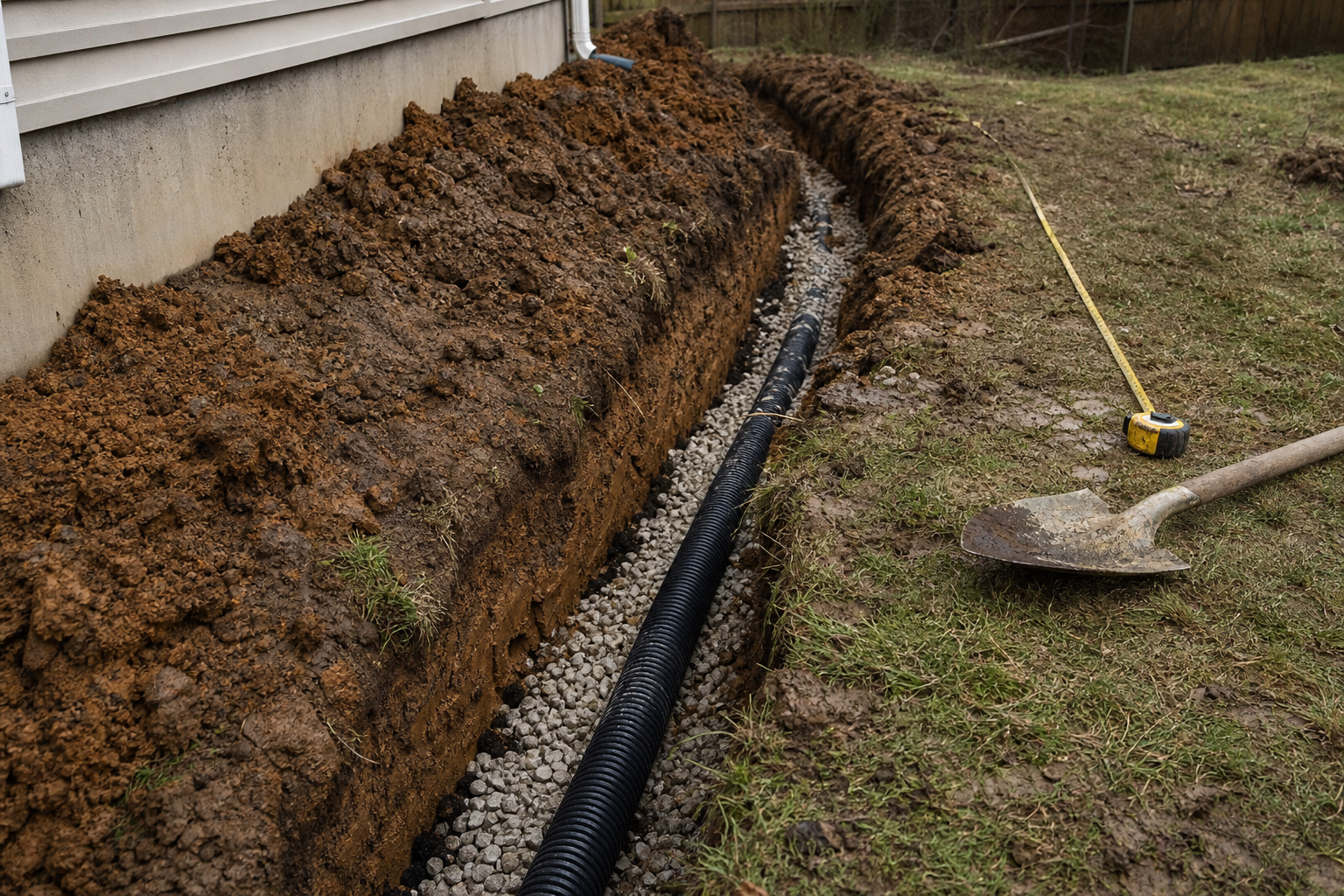
The French drain is probably the most talked-about and most frequently misapplied drainage solution. A true French drain is a gravel-filled trench with a perforated pipe at the bottom, designed to intercept subsurface water—the water moving through the soil itself. It's not primarily for surface water. If you have a soggy hillside that is constantly "weeping" water, a French drain installed across that slope can intercept that water and carry it away.
In the heavy clay of the Sioux Empire, French drains have specific challenges. The clay particles are so fine they can quickly clog the gravel and the fabric wrap (the "sock") often sold with perforated pipe. For this reason, we often recommend against using the fabric sock in our local soils and instead use a clean, washed drainage rock and a slightly steeper pipe slope to keep water moving fast enough to flush out sediment. The most critical part of any French drain is a positive outlet. The pipe must "daylight" to a lower point in the yard, a storm drain (with proper permits), or a dry well, otherwise it's just a water-filled trench. It has to go somewhere.
Surface Water Catchers: Channel Drains and Catch Basins
If your problem is surface water running across a patio, driveway, or other hard surface, a French drain is the wrong tool. What you need is something to catch the water at the surface.
- Channel Drains: These are long, narrow grates set in concrete. You see them at the bottom of driveways or across garage entrances. They are incredibly effective at intercepting a wide sheet of water and funneling it into a solid drain pipe.
- Catch Basins: These are simply boxes (typically 9-inch or 12-inch squares) with a grate on top, placed at a low spot in the lawn or landscape bed. Water pools, falls into the basin, and is carried away by an underground pipe. They are excellent for dealing with stubborn low spots where regrading isn't practical.
Both of these systems require a solid, non-perforated pipe to carry the captured water to a discharge point.
Living Solutions: Swales and Rain Gardens
Sometimes the best way to manage water is to work with it, not just pipe it away. "Soft" solutions like swales and rain gardens are becoming more popular in and around Sioux Falls because they are effective, environmentally friendly, and can be beautiful landscape features.
A swale is one of the oldest drainage tricks in the book. It’s simply a wide, shallow, gently sloped channel, often lined with grass or river rock. Instead of concentrating water in a pipe, a swale guides it slowly across the landscape, giving it more time to soak into the ground without causing erosion. It's a subtle way to direct runoff from a large area, like a long sloping backyard, toward a safer discharge area. They blend into the lawn and you can often mow right through them.
A rain garden is a more focused solution. This is a shallow depression in the landscape that is intentionally designed to collect runoff from a roof or driveway. The garden is filled with amended soil to improve drainage and planted with deep-rooted, water-loving native plants that thrive in our USDA Zone 4b/5a climate. A rain garden acts like a temporary pond. It fills with water during a storm, holds onto it for a few hours to a day, and allows that water to slowly filter into the ground and be used by the plants. This reduces the burden on storm drains and recharges groundwater. It's a fantastic way to turn a drainage problem into a beautiful, low-maintenance garden feature.
Dealing with Our A-Plus Clay Soil
Let’s be direct about our soil. You cannot truly "fix" eastern South Dakota's heavy clay on a large scale. Many homeowners try to improve their lawn by topdressing with a few inches of black dirt. While this might provide a temporary improvement and a better seedbed, it doesn't solve the underlying drainage problem. You've essentially just put a thin layer of sponge on top of a ceramic bowl. The water will soak through the nice topsoil and then hit the impermeable clay layer and stop, creating a saturated zone right at the root level.
Significant soil amendment involves mechanically blending huge amounts of sand and compost many feet deep, a process that is prohibitively expensive and impractical for an existing residential lot. It's far more effective to accept the nature of the clay and focus on managing the water on top of it.
That being said, one practice that does help is core aeration. This is the process of pulling small plugs of soil out of the lawn. This doesn't change the soil type, but it does temporarily relieve compaction. The holes create channels for air, water, and nutrients to penetrate deeper into the root zone. A lawn that is regularly aerated will be healthier and slightly better at handling moisture than a heavily compacted one. Think of it as a helpful management practice, not a full-blown drainage solution.
Protecting Your Investments: Hardscapes and Foundations
Water is relentless, and nowhere is that more obvious than in its effect on expensive hardscapes like patios and retaining walls. This is where planning for drainage is not just smart; it's essential for protecting your investment, especially with our dramatic freeze-thaw cycles.
When water gets trapped behind a retaining wall, it creates immense hydrostatic pressure. This pressure can bulge, crack, or even completely topple a wall that wasn't built with proper drainage. Every professionally-built retaining wall must include a drainage zone of clean gravel and a perforated pipe at the base to relieve this pressure. The pipe collects water and safely routes it out from behind the wall.
The same principle applies to paver or concrete patios. If the base material under your patio becomes saturated with water and then freezes, you get "frost heave." The expanding ice can lift entire sections of your patio, creating uneven surfaces, cracked pavers, and a massive tripping hazard. A properly installed patio must start with a well-compacted base and be graded to shed water away from the house and off the surface. Often, we incorporate channel drains or other landscape drainage solutions right into the patio design to ensure water never has a chance to sit and cause trouble. Paying for drainage upfront during construction is always cheaper than tearing out a failed patio five years down the road.
When to Call a Pro
While extending a downspout is a great DIY project, many drainage issues require professional expertise and equipment. You should seriously consider calling a company like ours if you encounter any of these scenarios:
- Water is threatening your foundation. If you have visible moisture in your basement or major pooling against your house, don't wait. This is the number one reason to seek professional help.
- The problem is widespread or complex. If you have multiple low spots, runoff from neighbors, or a large, flat yard with nowhere for water to go, you likely need a comprehensive plan.
- You're planning new construction. Integrating drainage into a new patio, addition, or landscape project from the beginning is vastly more effective and affordable than retrofitting it later.
- The solution requires significant regrading. Moving large amounts of soil to change the slope of your yard requires heavy equipment and a detailed understanding of how to achieve the correct grade.
- Your discharge point is unclear. Figuring out where the water can legally and effectively be discharged can be tricky. This sometimes involves connecting to municipal storm systems, which almost always requires a permit and inspection from the city of Sioux Falls.
- You suspect you need a French drain or other piped system. Installing these systems correctly—with the right slope, proper materials, and a viable outlet—is critical to their success. A poorly installed French drain is just a buried, expensive swamp.
The Bottom Line
Living in eastern South Dakota means living with dramatic weather and challenging soil. You can't fight the rain, and you can't replace your whole yard. The key is to manage the water intelligently. By understanding how water moves on your property and implementing the right combination of grading, downspout control, and, if needed, engineered systems, you can turn a soggy, problematic yard into a healthy, stable, and enjoyable landscape. It's about guiding water, not just getting rid of it, and in doing so, protecting the most significant investment you have: your home.