
Landscape Design Ideas for Sioux Falls Homes
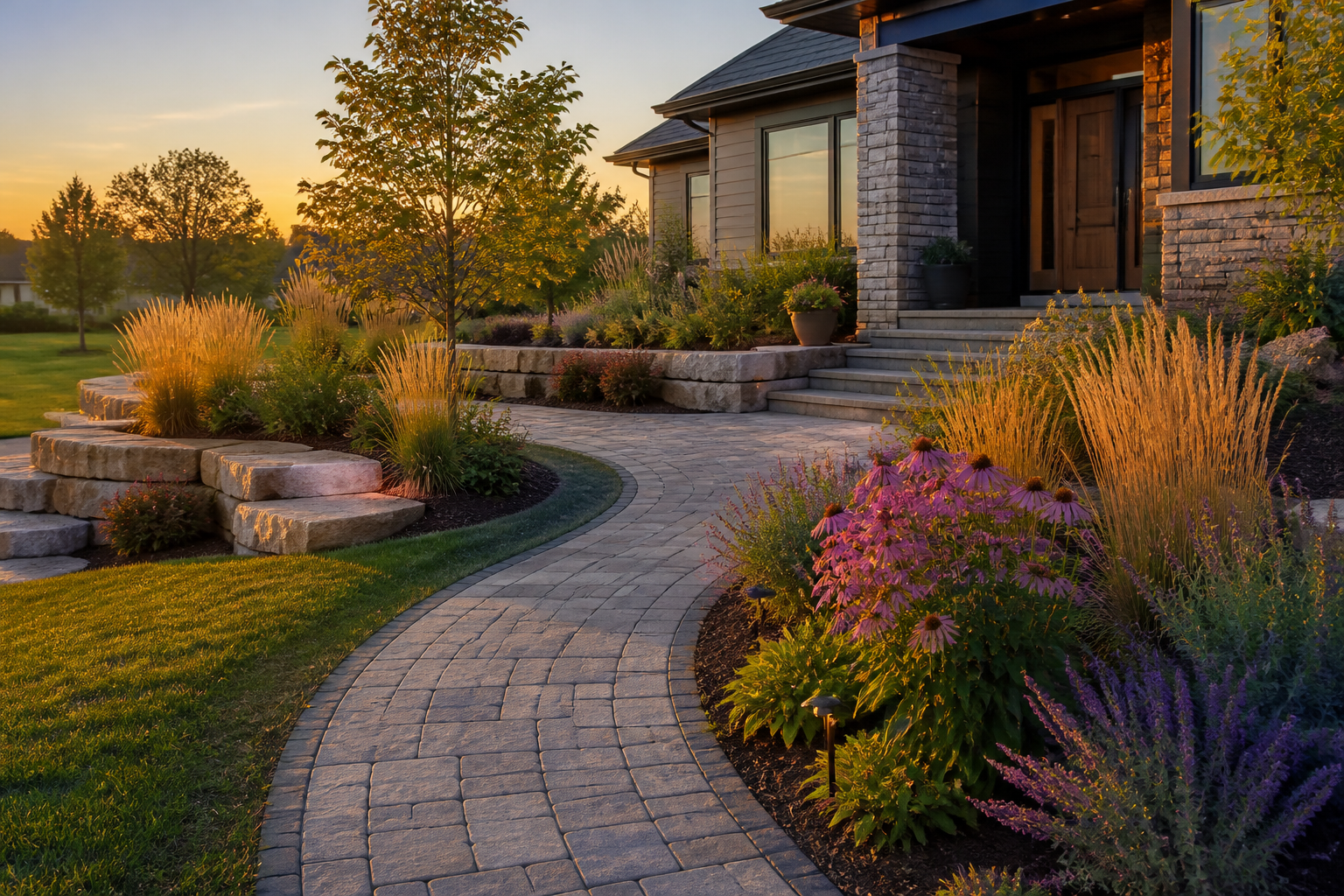
Designing a landscape in Sioux Falls is fundamentally different from designing one in Kansas City, Minneapolis, or Des Moines. We contend with a very distinct set of natural forces: dense, alkaline glacial till clay; brutal winter winds that rip across open prairie; a hard frost line that drives 42 to 48 inches deep; and rapid temperature swings that can send a thermometer from 65 degrees down to 10 degrees in under twenty-four hours.
Add to that our typical frost dates—averaging around May 5 in the spring and October 1 in the fall—and you have a climate that punishes lazy designs. When a yard is designed strictly from a glossy national magazine, it fails here. Retaining walls blow out from hydrostatic freeze pressure. Broadleaf evergreens burn to an orange crisp by mid-February. Patios heave, downspouts flood basements, and foundation plantings drown in sticky clay trenches.
Good landscape design in Sioux Falls marries smart engineering with regional aesthetics. Whether you are building in a new development out near 85th and Western, updating an established ranch in the Cathedral district, or trying to carve out privacy on a windy lot near Harrisburg, this guide walks you through the practical, high-impact strategies that make local yards functional, durable, and beautiful.
Start with the Subsurface: Fixing the Glacial Clay Reality
Before you sketch a single patio curve or pick out a shrub, you have to talk about what sits six inches below your sod. Most of Minnehaha and Lincoln counties rest on heavy clay loam. Clay holds nutrients reasonably well, but it compacts like concrete and drains at a crawl—often less than an inch per hour.
When new homes go up around southeastern South Dakota, heavy earthmoving equipment packs that clay down further. The builder rolls out two inches of stripped topsoil, lays Kentucky bluegrass sod, and calls it finished. Homeowners then spend years fighting pooling water, dead root systems, and muddy dog tracks.
Every successful landscape design strategy starts with grading and water movement:
- Establish positive slope away from the structure: Your grade must drop at least six inches over the first ten feet out from your foundation walls. If your lot grade is flat, your design needs swales, raised beds, or subsurface piping.
- Bury downspouts into solid PVC: Corrugated black flex pipe is a disaster in our climate; it crushes easily, catches debris in its ridges, and ruptures during heavy winter freezes. Use smooth-walled 4-inch rigid PVC (Schedule 40 or thin-wall SDR 35) pitched to daylight away from your home or into an engineered dry creek bed.
- Use swales instead of fighting the natural grade: If your lot takes run-off from two neighboring yards, do not fight that water with topsoil fill. Carve a broad, shallow grassy swale or a stone-lined drainage creek that turns stormwater into a defined visual boundary.
- Decompact planting zones: Do not just dig a bowl in the clay and drop in a tree. That creates a subterranean bucket where roots sit in stagnant water and rot. Till organic matter across entire planting areas, or build planting beds up above grade rather than digging down.
When drainage is resolved on paper, the fun part begins: laying out spaces that balance curb appeal, family living, and winter resilience.
Front Yard Layout Strategies: Balancing Curb Appeal with Prairie Realities
A front yard has one primary job from the street: anchor the architecture of the house to the ground while providing a welcoming, effortless path to the front door. Yet drive through southern Sioux Falls neighborhoods and you see the same two mistakes on every block: narrow four-foot concrete walkways pressed tight against the garage, and a token pair of spindly arborvitae planted three feet away from the siding.
To build a front yard that actually works, rethink your structural layout:
The Widened Entry Sequence A standard 36- or 48-inch sidewalk feels stingy. Two adults cannot walk side by side from the driveway to the front door. By expanding the walkway to 5 to 6 feet wide—or widening it at the landing—you immediately change the visual scale of the entire property.
Use natural materials or textured concrete pavers that tie into your home’s stone or brick veneer. If your home has a dominating two- or three-stall garage that sticks out toward the street (the classic Midwest "snout house"), design your entry walk to branch off the driveway wide and early, curving slightly toward the porch with generous planting beds buffering the concrete. This draws the eye away from garage doors and toward the front entrance.
Deep, Layered Foundation Beds Stop planting foundation beds that are four feet deep. They force you to plant in a single straight row, which makes houses look squat and two-dimensional.
Bring your foundation beds out to eight, ten, or even twelve feet deep. This gives you room for three distinct vertical layers: 1. The Backdrop (4 to 8 feet high): Hardy deciduous shrubs like Dogwood, Ninebark, or Viburnum placed far enough off the wall (minimum 4 to 5 feet) so they do not trap moisture against your siding or rub shingles in the wind. 2. The Mid-Tier (2 to 4 feet high): Compact hydrangeas, spirea, or dwarf conifers that carry color or texture through midsummer. 3. The Foreground (Under 2 feet high): Massed perennial groundcovers, prairie dropspot, or stone outcroppings that soften the hard edge between mulch and turf.
The Anchor Tree: Size and Placement Never plant a tree where it will outgrow its space in fifteen years. A common blunder is planting an Autumn Blaze Maple eight feet from the front corner of the foundation. Within a decade, the limbs scrape gutters, shade out every lawn blade beneath it, and lift the sidewalk.
Instead, pull shade trees out into the yard twenty feet from the house, or choose intermediate ornamental trees for close-in framing—such as an Autumn Brilliance Serviceberry, a Pagoda Dogwood, or a Japanese Tree Lilac. These species stay under 20 to 25 feet, feature multiple seasons of interest, and will not destroy foundation lines.
Backyard Living Spaces: Creating Sheltered Microclimates
Designing a backyard in Sioux Falls requires serious thought about wind, sun exposure, and seasonal transitions. Our backyards face two extremes: blazing afternoon sun in July with temperatures in the 90s, and whipping northwest winds in the shoulder months that make an open patio miserable by late September.
A great backyard layout uses hardscape and plant material to engineer sheltered microclimates—spaces where you can comfortably sit outside three or four weeks earlier in the spring and a month later into the autumn.
Strategic Hardscape Positioning Where you place a patio dictates how often you use it. If you put an unshaded concrete pad directly off the west side of your home, you will abandon it from 4:00 PM to 8:00 PM all summer long because the heat radiating off the siding and the slab is intolerable.
- Morning-Sun Patios: Placing a secondary coffee terrace on the east or northeast side of the home gives you cool, wind-protected space during hot summer evenings.
- Sunken or Enclosed Spaces: By dropping a fire pit patio eight to twelve inches below the surrounding grade and wrapping it with an 18-inch seat wall, you create a wind block that retains heat from a gas or wood fire pit, extending usability into late November.
- Covered Structures: Pergolas with drop-down wind screens or solid-roof pavilions on the west side are essential if you want true multi-season outdoor dining in the upper Midwest.
Hardscape Material Selection for Zone 4b Freeze-thaw performance separates professional hardscaping from weekend DIY attempts. In eastern South Dakota, the ground moves. Water gets underneath pavers, freezes, expands by 9%, and pushes materials out of alignment.
If you are laying a paver patio or building a retaining wall: - Base depth is non-negotiable: Never build on less than 6 to 8 inches of densely compacted crushed aggregate base (such as 3/4-inch crushed quartzite or road base) topped with 1 inch of bedding sand or open-graded chips. - Sioux Quartzite is your best friend: Our native pink quartzite is one of the hardest stones on earth. It does not absorb water, it will not flake or shale after five winters, and it offers incredible natural structural stability. - Avoid soft sandstones and cheap cast concrete: Softer manufactured products look fine for three years, but road salt, fertilizer, and freeze cycles will cause their faces to spall and pit. Choose dense, high-compressive-strength pavers tested for harsh northern climates.
Plants That Actually Thrive in Sioux Falls (And Ones to Avoid)
The USDA puts Sioux Falls in Zone 4b, with occasional winter snaps dipping near Zone 4a (-25°F to -30°F). However, cold hardiness is only half the battle. Our plants must also survive alkaline soils (pH levels typically between 7.2 and 7.8) and heavy clay that limits oxygen exchange.
If you choose acid-loving plants, you will spend hundreds of dollars on soil amendments only to watch leaves turn sickly yellow from iron chlorosis. Here is what works, and what routinely breaks hearts:
High-Performance Shrubs and Structural Plants - **Ninebarks (*Physocarpus opulifolius*):** Varieties like 'Diabolo', 'Summer Wine', or 'Amber Jubilee' are absolute workhorses. They handle our wind, take alkaline clay in stride, and provide deep wine-red to bronze foliage that breaks up green lawns. - **Panicle Hydrangeas (*Hydrangea paniculata*):** Unlike the finicky blue mophead hydrangeas (*Hydrangea macrophylla*) that fail to bloom here because of winter dieback, panicle varieties bloom on new wood. 'Limelight', 'Little Lime', 'Bobo', and 'Quick Fire' thrive in full sun to partial shade and produce massive blooms that dry on the plant for striking winter texture. - **Dogwoods (*Cornus sericea*):** Red-osier dogwoods provide winter color that pops brilliantly against fresh snow. Use varieties like 'Arctic Fire' for compact growth along foundation beds or drainage swales. - **Viburnums:** From the compact 'Mohican' to the drought-tolerant Nannyberry, viburnums offer heavy spring blossoms, great fall foliage, and bird-friendly berry sets.
Perennials and Prairie Grasses Modern prairie aesthetics fit modern Sioux Falls architecture naturally. They cut maintenance, use less water, and look best in late summer when other yards are looking tired.
- Karl Foerster Feather Reed Grass: The gold standard for vertical structure. It greens up early in April, stays upright against 40 mph prairie gusts, and provides reliable 5-foot privacy screens throughout winter.
- Prairie Dropseed (*Sporobolus heterolepis*): A native bunchgrass with an arching, fountain-like habit that turns a rich golden-orange in the fall. Outstanding for massing along front walkways.
- Purple Coneflower (*Echinacea purpurea*) and Black-Eyed Susan (*Rudbeckia*): Inexpensive, bulletproof perennials that feed pollinators and laugh off 95-degree heat waves.
- Russian Sage (*Salvia yangii*): Thrives in brutal, dry, sunny spots where other perennials wilt. Its silvery foliage and purple plumes look phenomenal set against tan quartzite outcroppings.
Plants That Struggle in the Sioux Empire Save yourself the frustration and cross these off your design list: - **Blueberries and Azaleas:** Require an acidic pH of 4.5 to 5.5. In our 7.5+ pH clay, they will slowly starve. - **Boxwoods (without heavy protection):** While cold-hardy boxwoods exist, Sioux Falls winter winds strip moisture from broadleaf foliage while the ground is frozen solid, leaving you with bronze, dead tops by March. If you must have evergreen borders, look at dwarf conifers or use deciduous alternatives like 'Alpine Currant'. - **Colorado Blue Spruce:** Once planted everywhere, they are now ravaged across the upper Midwest by needle cast diseases and cankers driven by humid summers. Replace them with Black Hills Spruce (*Picea glauca* var. *densata*) or Concolor Fir (*Abies concolor*), which tolerate our conditions far better.
Low-Maintenance Bed Prep: Edging and Mulch Strategies
The average homeowner does not want to spend twelve hours every weekend pulling weeds and edging beds. Smart structural choices in your landscape design keep maintenance down to an hour or two a month.
Stone Mulch vs. Wood Mulch There is constant debate among Sioux Falls property owners regarding rock versus shredded bark mulch. Both have clear applications:
- Shredded Hardwood Bark: Bark cools the soil, breaks down over time to improve the heavy clay underneath, and holds moisture well. It is mandatory around acid-sensitive perennials, annuals, and soft-stemmed shrubs. However, light wood chips blow away in wind gusts. Use double-shredded hardwood mulch, which interlocks and stays anchored. Expect to top it off every two years.
- Rock Mulch (River Rock or Quartzite): Rock does not blow away, making it popular for windy, open lots. It is phenomenal for drainage beds, around downspouts, and along windward exposures. But keep this in mind: rock absorbs heat and radiates it back into the soil, stressing shallow-rooted plants. Keep rock beds away from delicate plantings, and always use commercial-grade woven geotextile fabric beneath it—never non-porous black plastic, which smothers the soil and kills microbial life.
Concrete Curbing and Steel Edging Spade-cut edges look clean in England, but in South Dakota's aggressive Kentucky bluegrass lawns, grass rhizomes will jump a natural dirt edge in three weeks.
To create a hard stopping line between lawn and planting beds: - Commercial Steel Edging: 14-gauge or 1/8-inch steel edging driven deep with structural stakes provides a clean, modern, minimalist line that mower wheels can ride right over without damaging the blades. - Extruded Concrete Curbing: Highly popular throughout Sioux Falls suburbs because it creates a solid physical barrier that holds mulch in and grass out. Ensure the contractor cuts expansion joints every 3 to 4 feet to accommodate ground heave during the winter freeze.
Integrating Smart Irrigation into the Landscape Plan
You cannot talk about landscape design in our region without discussing supplemental watering. Our rainfall patterns are unpredictable. We might receive four inches of rain in June, followed by seven weeks with nothing but blistering wind and ninety-degree sun.
A common pitfall is installing the irrigation system as an afterthought once the plants are already in the ground. The landscape layout and irrigation plan must be designed in tandem.
- Separate turf zones from planting zones: Lawn grass needs deep, infrequent overhead watering (typically 1 to 1.5 inches per week). Shrubs and perennials rot if hit with that much overhead water. Run separate low-pressure drip irrigation zones to your planting beds. Drip applies water right at the root zone with zero wind drift and minimal evaporation loss.
- Smart Weather Controllers: Modern irrigation systems should include smart Wi-Fi controllers equipped with rain sensors. If an inch of rain dumps on the south side of town, your system should automatically skip its morning run, saving water and preventing root rot.
- Winterization access: Remember that every irrigation system in Sioux Falls must be blown out with high-volume compressed air before mid-October. Design your backflow preventer and mainline manifolds in accessible locations where a technician can hook up equipment without trampling your perennial borders.
Step-by-Step: How to Plan Your Sioux Falls Landscape Project
If you are staring at a blank mud lot or an overgrown mess from 1985, tackling an entire yard design feels overwhelming. Break the project down into an orderly, logical progression:
1. Map Your Problem Areas First: Note where winter winds howl across the yard, where the sun bakes the patio in the summer, and where standing water gathers after a spring thaw. Solve structural problems before picking out decorative features. 2. Determine Circulation and Hardscape Footprints: Sketch the paths you take daily. Where do you walk from the driveway to the back gate? Where do the kids take their bikes? Build walkways and patios large enough to accommodate actual movement and outdoor furniture sets. 3. Establish Evergreen and Hardscape Anchors: Place the year-round bones of your yard first. This includes patios, retaining walls, boulders, utility screening, and structural trees. These elements give the yard shape during our six months without green foliage. 4. Fill with Functional Plant Groupings: Layer your shrubs and perennials in masses of three, five, or seven plants rather than single specimen dots. Grouping plants creates sweeping ribbons of color and texture that feel deliberate and natural. 5. Install Irrigation and Edging: Put in your infrastructure lines, edging barriers, and bed soil prep before fine mulches and sod go down.
Common Sioux Falls Landscape Design Questions
How close to my house can I plant trees and large shrubs? Keep large shade trees (Maples, Oaks, Lindens) at least 15 to 20 feet away from your foundation. Planting them closer risks root intrusion on sewer lines, damaged foundation drains, and heavy limbs hanging over shingles. Intermediate trees (Serviceberry, Crabapple) should sit 8 to 12 feet away, while medium foundation shrubs should be placed so that their mature width keeps them at least 18 to 24 inches clear of your exterior walls. This preserves airflow and keeps insects away from your siding.
When is the best time of year to complete a landscape install in eastern South Dakota? Spring (late April through early June) and late summer/early fall (mid-August through late September) are prime planting windows. Fall is actually our favorite time for planting trees, shrubs, and sod; the air is cooler, soil temperatures are warm, and plants spend their energy establishing roots rather than battling high summer heat. Just be sure all new plantings receive deep watering until the ground freezes in late November.
How do I handle steep backyard slopes common in newer Sioux Falls subdivisions? Many new developments in the area feature walk-out basements with dramatic rear slopes. The worst approach is trying to mow a 3:1 slope covered in grass. Instead, terrace the slope using engineered segmental retaining walls or dry-stacked Sioux quartzite. Terracing creates distinct flat levels for patios, fire pits, or shrub beds, completely eliminating mowing danger while controlling stormwater runoff.
Building a Landscape That Lasts
A well-executed yard transformation adds immediate usable square footage to your home while permanently fixing the water and grade problems native to our region. It requires looking beyond what looks pretty on a sunny afternoon in June, designing instead for the torrential downpours of May, the baking drought of August, and the sub-zero blizzards of January.
If you are ready to rethink your outdoor space—whether it is solving chronic drainage issues, expanding your backyard entertaining footprint with durable hardscapes, or designing a clean, low-maintenance planting plan that thrives in our local soil—grounding your project in regional experience makes all the difference. Connect with our landscape design and installation team at Groundwater Inc. to walk your property, evaluate your site, and build a master plan crafted specifically for living well in the Sioux Empire.