
Built to Last: Hardscaping for Sioux Falls Freeze-Thaw
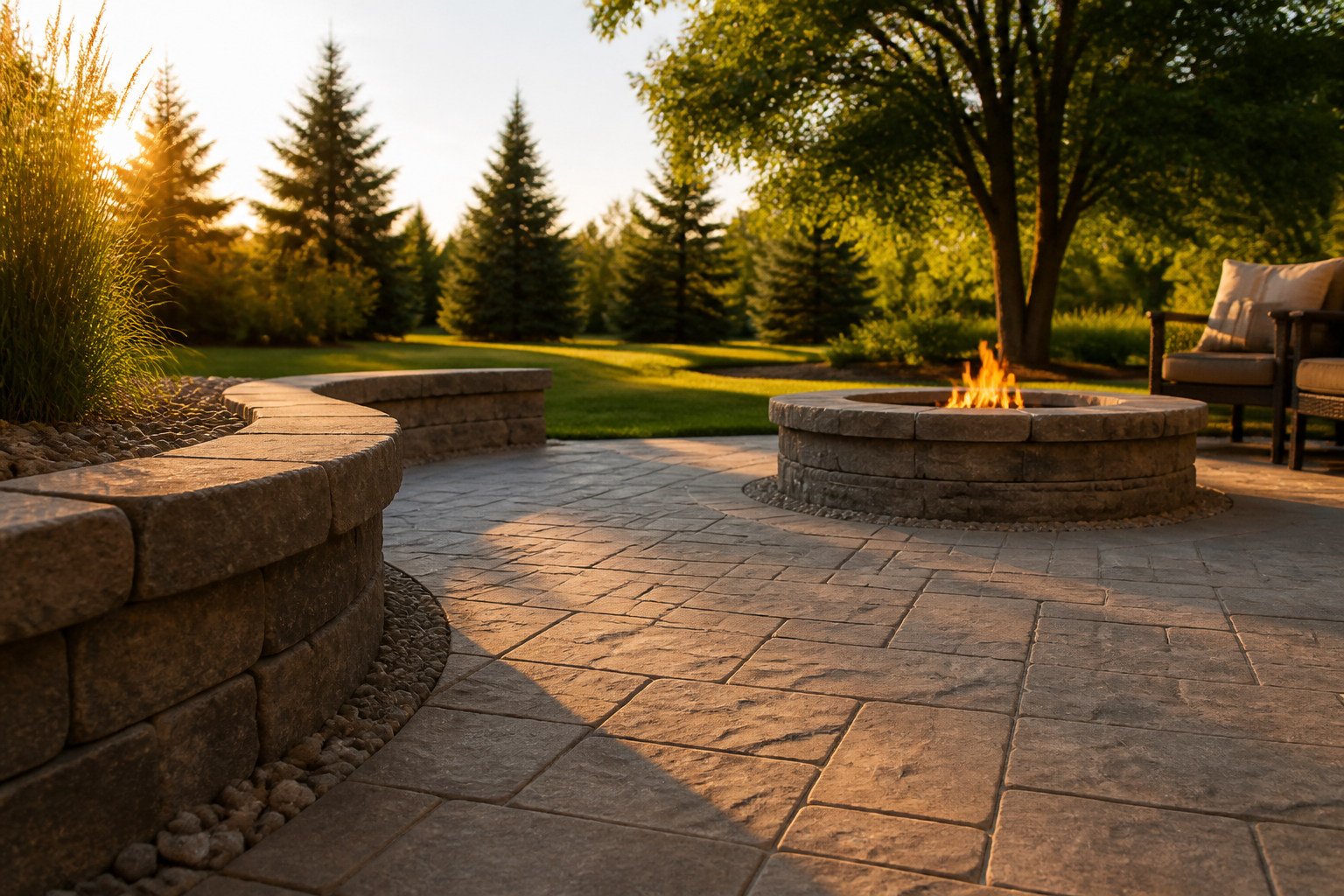
''' It’s a story we see too often in Sioux Falls. A homeowner invests in a beautiful new paver patio in June. It looks fantastic all summer. Then, after a long South Dakota winter, the spring thaw reveals a mess: pavers are heaved up, the surface is a lumpy, ankle-twisting disaster, and the whole thing looks like it was built by someone who’s never seen a frost cycle.
Here at Groundwater Inc., we’ve been building (and sometimes, rebuilding) hardscapes in the Sioux Empire for 50 years. We’ve seen what works and what gets torn apart by our extreme climate. The secret to a lasting patio or retaining wall isn’t a secret at all: it’s about acknowledging the power of frozen water and building accordingly. This isn’t a place for shortcuts.
This guide is our brain dump on how to do it right. We'll cover the nitty-gritty of why things fail, how to choose the right materials, and why the most important part of your patio is the part you can't see.
The Enemy: Freeze-Thaw Cycles
To understand how to build a durable hardscape in Sioux Falls, you first have to understand the forces trying to destroy it. The primary villain is the freeze-thaw cycle.
Here’s how it works: 1. Water Gets In: Our heavy clay soils hold moisture. Rain, snowmelt, and irrigation saturate the ground beneath your pavers or wall. 2. Water Freezes & Expands: When the temperature drops below 32°F, that water turns to ice. As it freezes, it expands with incredible force—about 9% in volume. This expansion pushes soil, gravel, and anything else in its path upwards. This is called frost heave. 3. Thawing & Settling: Come spring, or even during a mid-winter thaw, the ice melts. The soil structure that was pushed up now collapses. But it rarely settles back to its original position evenly. One area might drop more than another, creating dips and voids.
Repeat this cycle year after year, and a poorly built patio will literally tear itself apart from below. The pavers will shift, tilt, and settle unevenly, creating an ugly, unsafe surface.
The Foundation is Everything
You wouldn’t build a house on a shaky foundation. The same rule applies to your hardscape. The single biggest factor in the longevity of a paver patio or retaining wall in our region is the depth and quality of its base.
This is where many DIY projects and low-bid contractors fail. Skimping on the base saves time and money upfront, but it guarantees failure down the road. For a pedestrian patio in the Sioux Falls area, we consider a 10- to 12-inch deep compacted base to be the non-negotiable minimum.
Here’s what that cross-section looks like:
- Subgrade: This is your existing clay soil. We start by digging out at least 12-14 inches of it. The subgrade must be graded to slope away from your house (a minimum of 1/4" per foot) and compacted to create a stable, uniform starting point.
- Geotextile Fabric: Before we add any gravel, we lay down a heavy-duty, non-woven geotextile fabric. This is a critical step. It acts as a separator, preventing the gravel base from mixing with the clay subsoil over time. Without it, your expensive gravel will slowly get pressed down into the mud, and your base will lose its integrity.
- Gravel Base: This is the load-bearing workhorse of the system. We use a 3/4" crushed rock, often called "road gravel" or "Class 5." We install it in layers, or "lifts," of 2-3 inches at a time. Each lift is thoroughly compacted with a heavy plate compactor before adding the next. This creates a solid, interlocking base that is stable and allows water to drain freely.
- Bedding Sand: On top of the compacted gravel base, we place a 1-inch layer of coarse washed sand. This is *not* playground sand. It's a specific type of sand that the pavers are set on. This layer provides a smooth surface to make fine-tuned height adjustments but does not provide structural support. The base does the heavy lifting.
Choosing Materials That Last
Once the base is right, you can focus on the visible part. The good news is that modern concrete pavers and wall blocks are incredibly durable and well-suited to our climate if installed correctly.
- Concrete Pavers: High-quality concrete pavers are manufactured to have a high density and low water absorption rate. This makes them resistant to the spalling and cracking that can happen when water soaks in and freezes. We favor products from trusted regional manufacturers who understand our climate needs. The style is up to you—from classic brick shapes to large-format modern slabs—but the quality is non-negotiable.
- Retaining Wall Blocks: Similar to pavers, retaining wall systems are engineered to be dense and durable. The key to a long-lasting wall is not just the block itself, but the entire system: proper base, backfill with clean gravel for drainage, and the inclusion of perforated drain tile at the base to carry water away. For any wall over about 3-4 feet in our area, a professional design or engineering review is a must to account for soil pressure and hydrostatic forces.
- Polymeric Sand: This is the "grout" that fills the joints between pavers. It’s a sand mixture with a polymer additive. When activated with water, it hardens to lock the pavers together and resist weed growth and insect tunneling. It also helps prevent water from pouring directly through the joints into the base material, directing most of it off the sloped surface.
Design for Drainage
Every hardscape design should start with one question: "Where will the water go?" In Sioux Falls, with our intense summer thunderstorms and rapid spring melts, managing water is paramount. Our landscape design service always incorporates water management into every patio and retaining wall plan.
- Slope: Your patio surface must be sloped. A slope of 1/4 inch per foot is the standard. This might not sound like much, but on a 12-foot wide patio, that's 3 inches of fall. It’s subtle enough that you won't notice it when you're sitting at a table, but it’s enough to ensure that water moves away from your house and off the surface, rather than pooling or running back toward your foundation.
- Downspouts: Never, ever terminate a downspout onto or under a patio. We see this all the time. It concentrates a massive amount of water in one spot, super-saturating the base and guaranteeing a failure. We always integrate downspout extensions into our designs, routing them into underground pipes that discharge to a safer location away from the hardscape.
- Retaining Walls: A retaining wall is essentially a dam. You must give the water a way out. This is why we backfill with gravel and install a perforated drain pipe (a "toe drain") at the bottom of the wall, daylighting it at the end. This prevents hydrostatic pressure from building up behind the wall and pushing it over.
What about fire pits?
A built-in fire pit is one of the most popular hardscape features in our area. To build one that lasts, you need a steel insert (a fire ring) inside the block. Do not build a fire directly against the concrete blocks. While the blocks are durable, the intense, direct heat of a wood fire can cause them to dry out, become brittle, and eventually crack or spall. The steel ring contains the fire and protects the surrounding blocks, ensuring your fire pit lasts as long as your patio.
FAQ: Your Hardscape Questions Answered
Can I just put pavers over my old concrete patio?
This is a common question, and the short answer is no, not if you want it to last. While overlay systems exist, they are not a good solution for our climate. The underlying concrete slab will continue to crack and move during freeze-thaw cycles, and those cracks and shifts will transfer directly to the pavers on top, creating an uneven and unstable surface within a few years. For a permanent solution, the old concrete must be removed, and a proper paver base must be installed from scratch.
How much does a proper paver patio cost in Sioux Falls?
This is the "how much does a car cost" question. The price depends heavily on size, complexity, site access, and material choices. However, you should be prepared for a significant investment for a professionally installed, built-to-last patio. Be very wary of bids that seem too good to be true. Those contractors are almost certainly cutting corners on the base preparation, and you’ll be paying for it in a few years when your patio fails. A well-built hardscape is an investment in your home’s value and your family’s enjoyment.
It's a System, Not Just a Surface
If you take one thing away from this article, let it be this: a patio or retaining wall is a complete system. The beautiful pavers you see on top are just the final 10% of the project. The other 90%—the excavation, the soil compaction, the geotextile fabric, the deep gravel base, the drainage plan—is hidden underground. That hidden part is what will determine whether your hardscape is a 20-year investment or a 3-year headache.
Building for the long haul in South Dakota means respecting the power of our winters. When you’re ready to discuss a hardscape project that is designed and built to withstand the test of time, give us a call. We’d be happy to walk you through the process. '''